
Cafeteria and Lunchroom Sensory Challenges: What Actually Helps
The cafeteria is often the loudest, most crowded, least structured room your child enters all day. Here are the accommodations that actually help — including alternatives most families don't know to ask for.
If you ask a group of autism parents to name the single hardest part of the school day for their child, a surprising number will not say academics, transitions, or even the bus. They will say lunch.
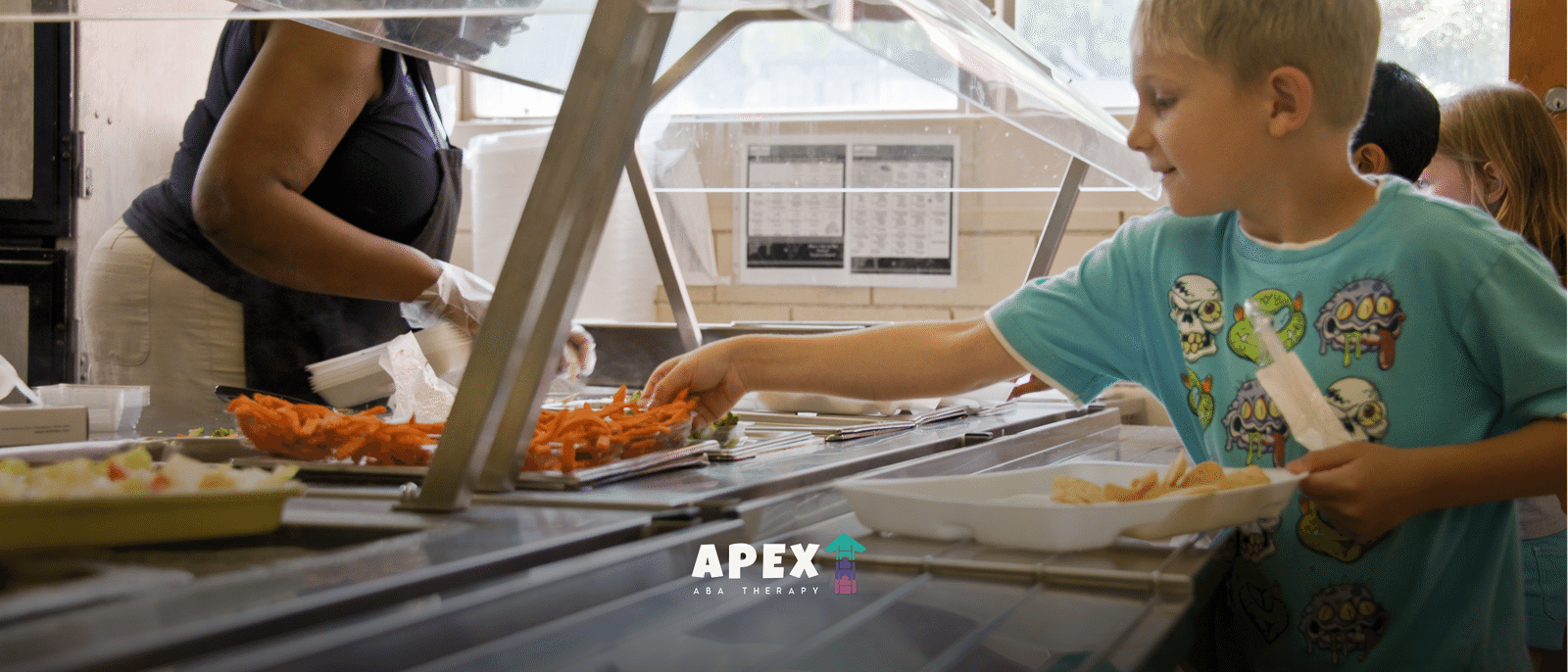
The school cafeteria is often the loudest, most crowded, and least structured room your child enters all day. It combines hundreds of overlapping voices, hard reflective surfaces that amplify sound, strong food smells, unpredictable movement, tight seating, time pressure, and the specific social demand of navigating who to sit with — often under far less adult supervision than any classroom setting. For an autistic child whose regulation is already stretched by a full morning of academic and social demands, the cafeteria can be the specific 20-30 minutes where everything falls apart.
The classroom teacher may report that your child was fine during math and reading and then had a hard afternoon. The cafeteria is often what happened in between.
The good news is that specific, achievable accommodations exist for exactly this problem. This article names why the cafeteria is uniquely difficult, covers the accommodations most worth requesting, and addresses the social dimension of unstructured lunchtime. The goal is that lunch stops being the invisible collapse point in your child's school day.
Why the Cafeteria Is Uniquely Difficult
Understanding the specific problems helps target the specific solutions. The features that make cafeterias hard for sensory-sensitive children:
Sound. Hundreds of children talking, moving trays, scraping chairs, laughing, shouting. All amplified by hard walls, high ceilings, and reflective floors that most cafeterias were designed with for durability rather than acoustics. Noise levels in school cafeterias routinely exceed 85 decibels, which the CDC identifies as the threshold above which noise starts to cause hearing damage over prolonged exposure. For an autistic child with auditory sensitivity, this is a physical assault, not just a preference.
Smell. Multiple hot foods, milk, cleaning products, and the collective smells of hundreds of packed lunches. Even neurotypical adults comment on how strong the smell of a school cafeteria is. For children with olfactory sensitivity, it can be overwhelming.
Visual chaos. Constant movement, fluorescent lighting, bright colors, hundreds of faces in motion. For a child whose visual processing is easily overloaded, the cafeteria is exhausting to be in even before they sit down.
Physical crowding. Tight seating at long tables, elbows touching, backpacks bumping, standing in line. Personal space is minimal.
Unpredictability. Who sits next to you today is different from yesterday. The lunch line moves differently. The menu changes. Someone drops a tray. A group of older kids walks through loudly. Nothing about the cafeteria environment is stable.
Time pressure. Most school lunch periods are 20-30 minutes. This includes standing in line, getting food, finding a seat, eating, and cleaning up. For a child who needs longer to transition, eat, or self-regulate, the pace itself is a stressor.
Reduced adult supervision. Cafeterias are often supervised by fewer adults than classrooms, and those adults are usually paraprofessionals or lunch aides rather than the child's classroom teacher. The child's daily anchor person is not present.
Social demands. Unstructured social time is often the hardest kind of socializing for autistic children (see the social section below). The demand of choosing who to sit with, joining an ongoing conversation, and reading dozens of overlapping social cues is genuinely difficult.
Any two or three of these might be manageable. All of them at once, every day, for an entire school year, is a lot.
The Alternative Eating Space: The Single Most Powerful Accommodation
The single most effective accommodation for cafeteria overload is often the simplest: your child eats somewhere else.
An alternative eating space can be a corner of the classroom with the teacher, the library, a small office, a resource room, or another quiet room in the building where your child eats lunch with one or two peers or a trusted adult. It does not eliminate the social dimension of lunch — friendships can happen at a quiet table too — but it eliminates the sensory overload of the main cafeteria.
This accommodation is routinely written into 504 plans and IEPs for autistic students and other students with sensory processing differences. It does not require a diagnosis of autism specifically — any student with documented sensory needs may qualify.
How to request it:
Include specific language in the IEP or 504 plan. Sample language:
"During lunch periods, [child's name] will have access to an alternative eating environment (classroom lunch corner, library, or designated quiet room) as needed. [Child's name] may invite one or two peers to eat with them in this alternative space to maintain social connection."
What to think through when requesting:
- Where specifically will the alternative space be? Ask for a specific location.
- Which adult will supervise?
- Is it available every day or only on specific days?
- Can your child bring a peer or two?
- Is it a permanent option or a "when needed" option? Both are legitimate.
Some children need the alternative eating space every day. Others need it as an option they can invoke on hard days. Both are valid. Neither is a lesser accommodation.
Common concerns and responses:
- "Isn't this isolating my child from peers?" Not if you build in peer inclusion (bringing a friend or two). Also, forced participation in an environment that produces daily meltdowns is not "socializing"; it's coercive exposure that reinforces avoidance and shame. A calm lunch with one friend is a better social experience than a hostile lunch with hundreds of children.
- "Isn't this just avoidance?" Providing accommodation for a documented sensory sensitivity is not avoidance. It's the same principle as providing a wheelchair ramp for a mobility need. The child can build tolerance for the main cafeteria over time (with intentional gradual exposure), but forcing daily exposure without accommodation is counterproductive.
Sensory Accommodations That Help in the Main Cafeteria
For families whose child will eat in the main cafeteria, either always or some days, several specific accommodations can meaningfully reduce sensory overload.
Noise-reducing headphones or earplugs. Approved in the IEP/504 as an accommodation the child can wear during lunch. Loop Quiet earplugs, Flare Calmer, and various children's noise-reducing headphones (over-ear versions from Puro, JBL, or specialty brands) all work. Some children prefer earplugs (less visible), others prefer over-ear headphones (more effective at reducing sound). Test what works before school starts.
Consistent seat. A specific assigned seat that doesn't change day-to-day. Preferably at the end of a row, next to a wall, or in a quieter corner of the cafeteria. Reducing daily unpredictability is one of the highest-leverage accommodations.
Consistent lunch buddy. One or two peers designated as lunch companions, ideally paired proactively rather than left to daily social negotiation. Some schools have formal "lunch buddy" programs; if yours doesn't, you can often set one up informally with the teacher.
Staggered entry timing. Arriving to the cafeteria 5-10 minutes before or after the main rush. Reduces line time, gives your child a chance to settle before the room fills, and reduces the acoustic peak.
Ear protection during transition times. The lunch bell, dismissal from class, and re-entering the classroom can all be high-intensity moments. Access to headphones or earplugs for these specific transitions can prevent the day-of buildup from tipping into meltdown.
Preferred seating away from high-traffic areas. Away from the trash cans, the water fountain, the entrance/exit, and any specific student known to be a source of chaos.
Access to a break. Permission to leave the cafeteria briefly (with a specific check-in with an adult) if regulation is slipping. Even a 3-minute break can prevent a 30-minute meltdown afterward.
Reduced or modified lunch time. For some children, a shorter lunch time in a quieter environment works better than the standard 25-30 minutes in the cafeteria. Discuss with the school.
Food-Related Considerations
Beyond sensory environment, food itself is often part of the lunchtime challenge for autistic students.
Packed lunch preferences. Many autistic students strongly prefer packed lunches to school-served food. Familiar containers, familiar foods, predictable presentation. This is legitimate. Schools cannot require students to eat cafeteria food, and packed lunches can be part of the accommodation plan.
Food sensitivity considerations. Some autistic children have significant food selectivity based on texture, smell, appearance, or temperature. If your child's food choices are limited, help the teacher and school staff understand that this is not defiance and does not require intervention during lunch itself.
Time to eat. Some children need more time to eat than others. The 15-minute actual eating window in most school lunch periods is not enough for many kids, autistic or not. If your child consistently comes home hungry, they may not have time to eat. Extended lunch time or eating in a less-rushed alternative space can help.
Snacks between meals. Access to preferred snacks at other times during the school day helps compensate if lunchtime eating is genuinely difficult. This is a reasonable accommodation to include in the IEP/504.
The Social Piece
Lunch is often the least structured social time in the school day, and unstructured social time is frequently the hardest kind of socializing for autistic students.
The classroom has structure. There are rules, seating charts, teacher-led activities, and clear roles. The playground has structure too, of a different kind — specific activities, games with rules, spaces with clear functions. The cafeteria has almost none of this. Who sits with whom, who talks with whom, what conversations get joined and how, are all improvised in real time by dozens of children with limited adult guidance.
For autistic students who find neurotypical social cues genuinely hard to read, unstructured lunchtime can be socially punishing. Being ignored or excluded during lunch is common. So is the reverse — being socially bombarded by well-meaning peers who don't know when to give space.
What helps:
- Consistent lunch buddies — a specific one or two peers your child sits with daily. Removes the daily social negotiation.
- Formal peer buddy programs — many schools have these; ask if yours does
- Small-group lunches in the alternative eating space rather than the main cafeteria
- Parallel eating as legitimate socializing — eating quietly alongside others without constant conversation is a valid form of social connection for many autistic children
- Explicit permission not to socialize during lunch if the child doesn't want to — sometimes lunch is the recovery time between social demands, and that's OK
- Coordination with a school counselor or SLP for social skill support around the specific challenges of unstructured social time
What often doesn't help:
- Forcing your child into a rotating lunch group as a way to "practice being social"
- Requiring participation in conversations
- Punishing quiet or solo eating as "not trying"
- Assuming that social isolation at lunch is evidence of a social skills deficit that needs correcting
The goal is a sustainable, humane lunchtime that reflects your child's actual social preferences and capacities. Some autistic children love social lunch. Others need lunch as a break from social demands. Both are legitimate.
Putting It in the IEP or 504 Plan
Verbal accommodations that everyone agrees on but aren't written down have a way of disappearing over the school year. If cafeteria accommodations matter to your child, get them in writing.
Sample IEP/504 language to consider:
Sensory accommodations during lunch periods:
- [Student] will have access to an alternative quieter eating environment (classroom lunch corner, library, or designated quiet room) as needed.
- [Student] may wear noise-reducing headphones or earplugs during lunch.
- [Student] will have a consistent assigned seat in the cafeteria when eating there, preferably in a lower-traffic area.
- [Student] may enter the cafeteria 5-10 minutes before the main rush to reduce sensory overload.
- [Student] may invite one or two peers to eat with them in the alternative space.
- [Student] has permission to take a 3-5 minute break outside the cafeteria as needed, with a check-in to [designated adult].
- Extended time to finish eating available as needed.
Adapt to what your child actually needs. Not every child needs every accommodation. What matters is that whatever your child needs is in writing so it doesn't depend on any one adult remembering.
Working with the School Toward Gradual Exposure
Accommodations are not the same as avoidance forever. For many families, the goal is a sustainable lunch situation now plus gradual exposure to more of the standard cafeteria environment over time — if and when the child is ready.
A useful long-term approach:
- Start with whatever accommodation combination works for your child at the current moment
- Meet with the school team quarterly to assess how lunch is going
- If lunch is stable and your child expresses interest, discuss gradual exposure (one day a week in the main cafeteria with a lunch buddy; a specific quieter table in the cafeteria; a "trial" lunch in the main space)
- Track how each exposure step goes. Move forward if it's manageable. Back off if it isn't.
- Do not remove accommodations before your child is ready. The point is expanding what your child can access, not testing whether they can tough it out.
Some children eventually eat happily in the main cafeteria. Others always need the alternative space. Both are legitimate outcomes.
When to Escalate
If your child's cafeteria situation is not improving despite documented accommodations, or if the school is not implementing the agreed-upon accommodations consistently, escalation options include:
- Request an IEP or 504 meeting to review and revise accommodations
- Ask for observation data (how often accommodations are being used, how the child is coping)
- Bring a private BCBA, therapist, or advocate to the next school meeting
- File a formal complaint with the district's special education office if legally required accommodations are not being provided
- Consult with a special education attorney for persistent issues
Federal law requires schools to implement the accommodations documented in an IEP or 504 plan. If they are not being implemented, you have legal recourse. Persistent unresolved cafeteria issues are worth pursuing formally, because chronic daily sensory overload has real cumulative effects on your child's regulation, energy, and mental health.
Recess and Lunch: A Note on the Connection
Recess is often paired with lunch, either immediately before or after, and both are unstructured environments with different sensory profiles. Many of the strategies here apply to recess as well — consistent buddies, adult check-ins, sensory tools, permission to opt out of the loudest activities. A separate article covers recess specifically. For now, if your child struggles with both lunch and recess, treat them as a paired problem and work with the school on strategies that flow between them, rather than solving each in isolation.
How Apex ABA Supports School Environment Accommodations
Cafeteria overload is often one of the specific problems that brings families to us for consultation. Apex ABA's Board Certified Behavior Analysts (BCBAs) work with families across North Carolina, Georgia, and Maryland on the specific school-based challenges that don't always fit neatly into an IEP meeting.
Where we can help:
- Assessment of cafeteria-specific triggers and coping capacity
- Support for parents in requesting and negotiating accommodations with the school
- Behavior support planning that includes the cafeteria environment
- Coordination with school-based ABA and classroom teachers
- Attending IEP or 504 meetings as parent support
- Home-side strategies for supporting regulation through the school day, including lunchtime
If your child struggles with the school cafeteria and you want to think about accommodations, gradual exposure, or a fuller behavior support plan, get in touch with our team to talk through what a coordinated approach might look like.
Frequently Asked Questions
1. Why is the school cafeteria so hard for autistic kids?
The cafeteria combines hundreds of overlapping voices amplified by hard reflective surfaces, strong food smells, bright lighting, tight seating, time pressure, unpredictability, reduced adult supervision, and the specific social demand of unstructured socializing. For autistic children whose regulation is already stretched by a full morning at school, any two or three of these might be manageable — all at once, every day, is often the specific 20-30 minutes where regulation collapses.
2. What is the most useful cafeteria accommodation?
For many families, an alternative eating space (a classroom corner, the library, a small resource room, or a quiet office) where the child eats with one or two peers or a trusted adult is the single most powerful accommodation. It preserves the social dimension of lunch while eliminating the sensory overload of the main cafeteria. Routinely written into IEPs and 504 plans for students with documented sensory needs.
3. Isn't eating in an alternative space isolating my child?
Not if you build in peer inclusion. Bringing one or two friends to the quieter space preserves social connection. And forced participation in an environment that produces daily meltdowns is not really "socializing" — it's coercive exposure that reinforces avoidance and shame. A calm lunch with one friend is often a better social experience than a hostile lunch with hundreds of children.
4. What accommodations can we request for the main cafeteria?
Common sensory accommodations include noise-reducing headphones or earplugs during lunch, a consistent assigned seat (ideally in a lower-traffic area), a consistent lunch buddy, staggered entry timing (arriving before the rush), preferred seating away from trash cans and high-traffic zones, permission to take a brief break outside the cafeteria if regulation is slipping, and extended time to eat.
5. How do we get these accommodations into an IEP or 504?
Verbal accommodations disappear over the school year. Get them in writing. Request a meeting with the IEP or 504 team, bring specific proposed accommodations, and ensure they're documented with clear language about who is responsible for implementation. Under IDEA and Section 504, schools are legally required to implement documented accommodations.
6. What if my child won't eat much at school?
Time pressure is often the culprit. Most school lunch periods have only 15 minutes of actual eating time after standing in line and finding a seat. Extended lunch time or eating in a less-rushed alternative space often helps. Also consider whether food selectivity or sensory issues with cafeteria food are contributing — packed lunches with familiar foods are usually accommodated. If your child consistently comes home hungry, this is worth addressing.
7. How should we handle the social dimension of lunchtime?
Lunch is often the least structured social time of the day, which makes it the hardest social environment for many autistic children. Strategies that help: consistent lunch buddies (removes daily social negotiation), formal peer buddy programs, small-group lunches in alternative spaces, treating parallel eating as legitimate social connection, and giving explicit permission for the child to opt out of socializing during lunch if they need it as recovery time.
8. Should we push our child to eat in the main cafeteria to build tolerance?
Only with accommodations in place and only through gradual, planned exposure — not through daily forced participation. Start with whatever combination works now. Assess quarterly. If lunch is stable and the child expresses interest, try planned exposure (one day a week in the main cafeteria with a lunch buddy, a specific quieter table, a trial with adult support). Move forward if it's manageable. Back off if it isn't. Some children eventually eat happily in the main cafeteria. Others always need the alternative space. Both are valid outcomes.
Sources
- Autism Speaks — Sensory Considerations in School Environments. https://www.autismspeaks.org/
- Loop Earplugs — Loop Quiet Noise-Reducing Earplugs. https://www.loopearplugs.com/
- Flare Audio — Calmer Noise-Reducing Earplugs. https://www.flareaudio.com/
- U.S. Department of Education — Individuals with Disabilities Education Act (IDEA), Accommodations Requirements. https://sites.ed.gov/idea/
- U.S. Department of Education — Section 504 of the Rehabilitation Act, Overview. https://www2.ed.gov/about/offices/list/ocr/504faq.html
- Center for Parent Information and Resources — Family Advocacy and IEP Resources. https://www.parentcenterhub.org/
- American Academy of Pediatrics (AAP) — Sensory Processing Considerations in Children. https://www.aap.org/
Get started today
Ready to talk about ABA therapy?
Apex ABA Therapy helps families in North Carolina, Maryland, and Georgia access in-home, school-based, and daycare ABA services.
Popular services
Serving families in